Pages

Showing posts with label Training Plans. Show all posts

Wednesday, January 18, 2012

More on training plans: All about Hal

I'm delighted to share a post here today written by my lovely friend Sharone, a kindred spirit and fellow average Jo runner.  Sharone provides a great introduction to perhaps the most popular and average-Jo-friendly of all the training plans, the Hal Higdon Plan. Please read on to learn how this training plan has enabled her to eat cheeseburgers run longer distances!
::

I backed into running against my will. My friend Kelsey convinced me to do a sprint triathlon, and once I pushed past the initial wanting to die stage that was my first few weeks of training, I realized that I kind of loved running. It was the most satisfying of the three sports, and it was the most efficient use of my workout time. Not to mention that it requires me to have more discipline and determination (confirmed) than skill (questionable). And it’s something I’ve come back to over and over in the four years since, especially for races.

Since the triathlon, I’ve run irregularly, usually 3 to 5 miles at a time. I’ve also done a few 5Ks. I never come anywhere near winning. I’m middle of the pack, happy to have lately worked my mile time to just around 10 minutes—and that’s one of the things I love most about running. Besides the fact that it keeps me in cheeseburgers (not an exaggeration), running offers a challenge to work harder and a chance to see measurable results. The Go Green St. Patrick’s Day Run will be my first half-marathon, and I’m really nervous terrified excited about it for that reason: it will be hard, and at the end I’ll be really proud of myself.

I’ve told you my running life story as a build-up to telling you why I chose Hal Higdon’s novice half-marathon training plan for this race. As Jo mentioned, the Hal program is based on the principle that gradually increasing total weekly mileage over twelve weeks will give runners the training they need to run longer races. Before I started Hal, I’d been working through a run-walk-run program that I loved, but as I came into the home stretch for the race, I wanted more experience running longer distances without stopping. Also, I know quite a few people who have used Hal and swear by him.

Maybe most importantly for me, I went with Hal because I found a way to make the training so easy that I barely have to think about it. I don’t have kids, but I’m writing a dissertation and working multiple jobs, so I need a program that doesn’t require a lot of mental exertion. Enter BluefinSoftware’s Hal Higdon’s Novice Half Marathon iPhones app. I’ve used their Ease into 5K and Bridge to 10K run-walk-run training programs and loved them, and this app is even better. It’s super easy to use. It tells you what distance to run or how much cross-training to do on which day. 
You can use audio from iTunes, Pandora, or any other music app you like, tap the go button, and it will tell you when to start running and when to stop. And it keeps track of your time, distance, and routes for all your workouts and puts them into pretty charts so you can see your progress (one of my favorite parts). 
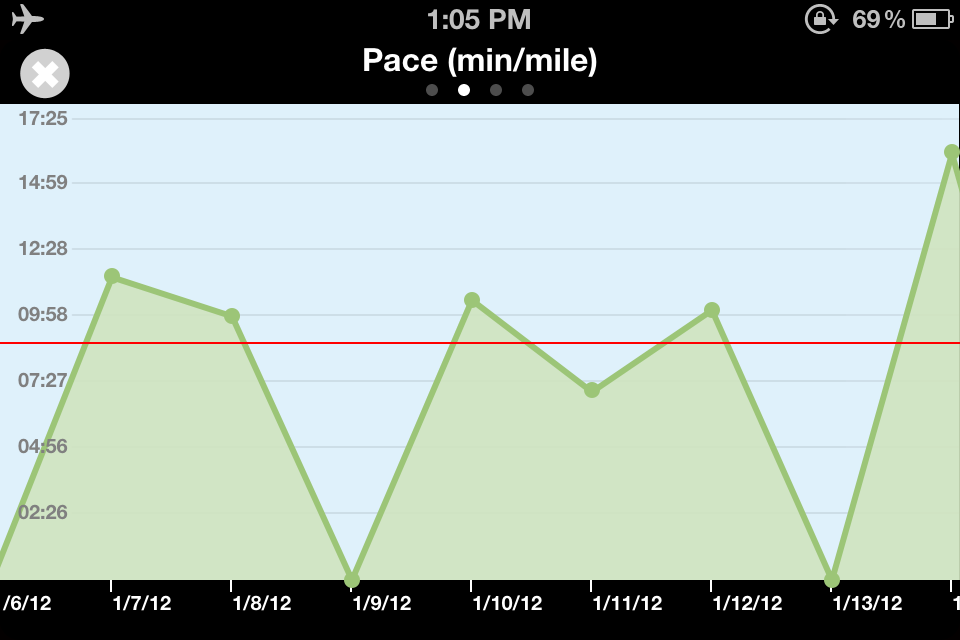
I love charts, and I love progress, so for me it’s perfect. It’s a little expensive for an app ($9.99), but if you can swing the money, I think it’s worth it.

So. The nitty gritty. Here’s how Hal’s plan works:

Each week of training consists of three running days, two easy cross-training days of 30-60 minutes each, and two rest days. Hal suggests running 2-3 miles on one of the cross-training days, which affects the total weekly mileage. He also suggests incorporating stretching and strength training somewhere into the week. But really, the plan’s very flexible.

* If you run the suggested races, Hal recommends rest for the two days prior to the race.

I’m a few weeks into Hal and I’m pretty happy so far. I’ve found that the suggested cross and strength training has made a huge difference in my running: better speed, energy, stamina, the whole deal. I like to combine the cross and strength/stretching by doing yoga or pilates, which are great because they give special attention to the joints that are getting the most strain. I feel stronger and more confident, and my mile times are coming down. All of these things make me really happy.

That’s probably the biggest thing I’m learning from all of this. The combination of Hal and the Bluefin app and the distances and cross-training really works for me, and it motivates me to train just as much as the 13.1 mile race I’m staring down in nine weeks.

What have you found that works for you? Hal Higdon? Some combination of plans? What do you do to make training as easy as possible?

Monday, January 9, 2012

First, we need a plan

My friend Elizabeth made my day when she chimed in to comment on yesterday's post:
"I really was someone who *knew* that I HATED running and would never be a runner, and I discovered I was wrong and that I could do it and that I would feel great. Point being: ANYONE can do it!
My next goal is to run a half marathon next fall. (I'm thinking this spring is too soon to double my distance?)"
I promptly replied to welcome her to Crazytown, and also to tell her that NO! Spring is not too soon! You can TOTALLY be ready by spring!!!

And no, I don't think using more exclamation points than actual words is overkill. It really is that exciting.

So let's talk about how to get ready for that spring half marathon, assuming this will be your first half, that you've already completed a Couch to 5k program or something similar and that you can comfortably jog four miles (at any pace).

There are a few major training approaches out there, all of which will adequately prepare you for the 13.1 mile distance:
  • Perhaps the most popular and traditional is Hal Higdon's plan, which relies on the time-tested principle of pure mileage accumulation. The assertion is that if you log the miles--no matter how slowly--you'll find yourself more than ready to tackle that half marathon, and at a (sometimes significantly) faster pace than you did in training.
  • Another approach is the Galloway plan, which encourages a run/walk/run method as a way to build both speed and endurance while decreasing the risk of injury. And don't assume that just because walking breaks are included as part of the training and the race itself that this plan isn't as difficult or effective. I have a friend who qualified for Boston using the run/walk/run method, an accomplishment that requires some serious grit and speed. 
  • Less well known, but gaining popularity is the FIRST training plan developed by Bill Pierce and Scott Murr. This is the plan I've followed loosely over the past year, and the one I'm going to highlight here not because I'm convinced it's superior, but because it's what I know.

The FIRST Training Plan (modified ever so slightly for the average Jo)

The FIRST program incorporates just three time-targeted runs per week, but at typically higher intensity than what other plans prescribe. The focus is efficiency--making the most of the time you have to train and making every mile count. So you'll do fewer runs and log less mileage overall, but purportedly achieve similar fitness results.

You can see then, why as a mother of two little ones, this plan appealed to me. Three runs per week as opposed to five. The plan strongly suggests cross training on two additional days, but I cross train sporadically at best. I figure I am lucky to be squeezing in the three runs. And also, I reason, Bill Pierce isn't the boss of me.

The three primary runs are as follows:
1. Speedwork - usually a 10 minute warm-up, followed by series of either 400m, 800m, or 1600m repeats, with 2 minute recovery jogs in between each rep., then cool down
2. Tempo run - a higher intensity run at 15 seconds faster than your targeted half marathon pace
3. Long run - a longer, more relaxed run at a pace of 30 seconds slower than your half marathon target

Because all of the suggested paces for training are based on your targeted half marathon pace, the first thing you'll want to do is set a realistic goal. The easiest way to do this is to use a recent 5K or 10k time and then reference this chart. Whatever you do, keep your goal realistic. Pushing yourself too hard too fast will only result in discouragement and increase your risk for injury.

If you read the entire Runner's World article covering the FIRST plan--which I encourage you to do--you'll see they use an example of a runner targeting a 1:30 half marathon. So...um...yeah, that's not even close to average.

Let's look at an example of the plan for average runner, shall we?

Half Marathon Goal: 2:11, 10 minute mile pace

Speedwork Paces: 

400s--HMP, minus 75 seconds (8:45 per mile), divided by 4: (2:11)
800s--HMP, minus 65 seconds, (8:55 per mile), divided by 2 (4:27)
1600s--HMP, minus 45 seconds (9:15 per mile)

Tempo Pace:
HMP minus 15 seconds (9:45)

Long Run Pace:
HMP plus 30 seconds (10:30)

And last but not least, the detailed mileage for the 10 week training plan:
Week Tuesday Wednesday Sat/Sun
1 4x400 3-mile tempo 6-mile long run
2 4x800 4-mile tempo 8-mile long run
3 3x1600 5-mile tempo 10-mile long run
4 6x400 6-mile tempo 6-mile long run
5 3x1600 4-mile tempo 10-mile long run
6 4x800 8-mile tempo 8-mile long run
7 6x400 6-mile tempo 10-mile long run
8 4x1600 8-mile tempo 12-mile long run
9 3x800 3-mile tempo 6-mile long run
10 4x400 2-mile tempo Half Marathon

Now if I may just say a few personal words about the plan. It worked for me. As in really well. I trained to run my first half just under two hours at a 9:05 pace. And I finished more than six minutes ahead of my goal. That being said, the tempo runs nearly did me in. I found them incredibly difficult. I whined for at least 48 hours in advance of each one. But I'm convinced the tempo runs were what made the difference for me in pushing myself to that next level of fitness.

Of course just because it worked for me doesn't mean it's the right plan for you. I'd encourage you to learn more about the other training plans and decide on an approach that best fits with your goals, your schedule, and your attitude toward running.


::

What about you? Have you already chosen and begun a training plan? If so, what plan are you using?  Are you considering using the FIRST plan to train for a half or full marathon? Do you have any questions about the plan or about training in general?