Now that we've covered a bit about training plans, let's talk about the gear you need to to help you get off on the right foot.
It's a run, not a runway.
Let's just establish this upfront. This ain't no fashion show. Sure, we all dream of gliding down the trail in a perfectly styled mix of Sporty Spice meets Nike ad. But Honey, if that dream doesn't die by the first mile, you can bet the third mile will do it in when you get a literal taste of what I like to call the Active Lifestyle Facial--the road-tested beauty formula of snot meets sweat. Let's just say this. If you still look pretty when you're finished, you didn't do it right.
A spring in your step.
I can't stress this enough: Professionally fitted running shoes are a must. I know it's fun to be matchy-matchy, especially when you have to spend the equivalent of a week's grocery budget on one stinkin' pair of shoes, but don't be tempted to select your shoes based on color or style or what's available in the clearance section at TJ Maxx. Instead,
concern yourself with finding the right fit, including the proper amount
of support to address pronation. Experts at your local running store
can analyze your gait and help you find the perfect shoes to support
your stride.
Running shoes generally need to be replaced every 300-500 miles, depending on the type of miles you've logged. I like to keep track of my miles on Dailymile so I always have an accurate count and don't have to rely on my fuzzy mathematical memory.
Music in your ears.
I know many of you out there are purists. You could run for miles just listening to the birds, the sound of the wind in the trees, the cars honking at you to get out of the blanketedy-blank way, and the sound of me whooshing past you as my new favorite running tune propels me forward. But for the rest of us normal folk who need a bit of music to beat the boredom and keep the pace, there are some great options for MP3 players and earbuds designed to
stay put. My personal favorite (and I've been through a few) is this one--as it incorporates my old school Shuffle with wireless headphones that won't fall off even after I reach speeds of 50 mph. (Because that totally happens. All the time.)
Time on your side.
For as little as $10, you can find a sports watch
with a clock and a timer. If you plan to run outdoors, this accessory is
essential for keeping track of your pace, not to mention ensuring you
make it back before the kids get off the bus or your lunch break ends. You don't need a fancy dancy GPS watch to get started (though that would be fun and those are wicked cool). Just strap on a plastic Timex, click over to chrono mode, and run like the wind.
Speaking of time, it's seems I've run out of it. I promise to write more soon, to include info on getting app-tly equipped, winter wear and hydration belts.
Any questions about gear so far? How's your training going so far? Please comment with your questions or share what gear, shoes, etc., you've found to work well for you. Thanks!
::
Don't forget, our Love146 donation site is up and running! Click over to make a donation or to set up your personal donation site if you've chosen to run a race with us. Also, there is still plenty of time to join in on the challenge at DailyMile!
Tuesday, January 24, 2012

Wednesday, January 18, 2012
More on training plans: All about Hal
I'm delighted to share a post here today written by my lovely friend Sharone, a kindred spirit and fellow average Jo runner. Sharone provides a great introduction to perhaps the most popular and average-Jo-friendly of all the training plans, the Hal Higdon Plan. Please read on to learn how this training plan has enabled her to eat cheeseburgers run longer distances!
::
I backed into running against my will.
My friend Kelsey convinced me to do a sprint triathlon, and once I
pushed past the initial wanting to die stage that was my first few
weeks of training, I realized that I kind of loved running. It was
the most satisfying of the three sports, and it was the most
efficient use of my workout time. Not to mention that it requires me
to have more discipline and determination (confirmed) than skill
(questionable). And it’s something I’ve come back to over and
over in the four years since, especially for races.
Since the triathlon, I’ve run
irregularly, usually 3 to 5 miles at a time. I’ve also done a few
5Ks. I never come anywhere near winning. I’m middle of the pack,
happy to have lately worked my mile time to just around 10
minutes—and that’s one of the things I love most about running.
Besides the fact that it keeps me in cheeseburgers (not an
exaggeration), running offers a challenge to work harder and a chance
to see measurable results. The Go Green St. Patrick’s Day Run will be my first half-marathon, and I’m really nervous
terrified excited about it for that reason: it will
be hard, and at the end I’ll be really proud of myself.
I’ve told you my running life story
as a build-up to telling you why I chose Hal Higdon’s novice
half-marathon training plan for this race. As Jo mentioned, the Hal
program is based on the principle that gradually increasing total
weekly mileage over twelve weeks will give runners the training they
need to run longer races. Before I started Hal, I’d been working
through a run-walk-run program that I loved, but as I came into the
home stretch for the race, I wanted more experience running longer
distances without stopping. Also, I know quite a few people who have
used Hal and swear by him.
Maybe most importantly for me, I went
with Hal because I found a way to make the training so easy that I
barely have to think about it. I don’t have kids, but I’m
writing a dissertation and working multiple jobs, so I need a program
that doesn’t require a lot of mental exertion. Enter BluefinSoftware’s Hal Higdon’s Novice Half Marathon iPhones app. I’ve used their Ease into 5K and Bridge to 10K run-walk-run
training programs and loved them, and this app is even better. It’s
super easy to use. It tells you what distance to run or how much
cross-training to do on which day.


You can use audio from iTunes,
Pandora, or any other music app you like, tap the go button, and it
will tell you when to start running and when to stop. And it keeps
track of your time, distance, and routes for all your workouts and
puts them into pretty charts so you can see your progress (one of my
favorite parts).
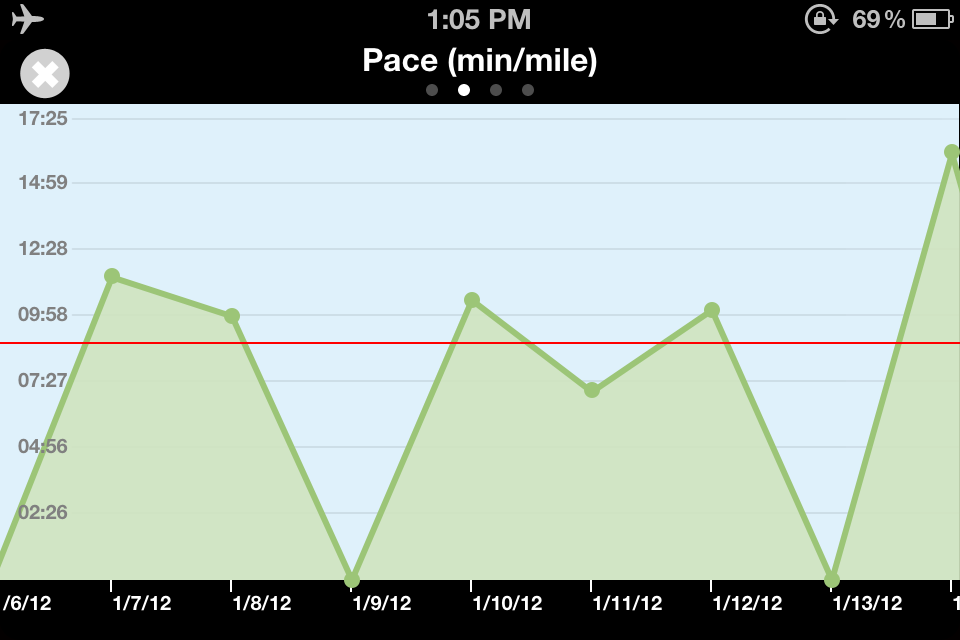
I love charts, and I love progress, so for me it’s
perfect. It’s a little expensive for an app ($9.99), but if you can
swing the money, I think it’s worth it.
So. The nitty gritty. Here’s how
Hal’s plan works:
Each week of training consists of three
running days, two easy cross-training days of 30-60 minutes each, and
two rest days. Hal suggests running 2-3 miles on one of the
cross-training days, which affects the total weekly mileage. He also
suggests incorporating stretching and strength training somewhere
into the week. But really, the plan’s very flexible.

* If you run the suggested races, Hal
recommends rest for the two days prior to the race.
I’m a few weeks into Hal and I’m
pretty happy so far. I’ve found that the suggested cross and
strength training has made a huge difference in my running: better
speed, energy, stamina, the whole deal. I like to combine the cross
and strength/stretching by doing yoga or pilates, which are great
because they give special attention to the joints that are getting
the most strain. I feel stronger and more confident, and my mile
times are coming down. All of these things make me really happy.
That’s probably the biggest thing I’m
learning from all of this. The combination of Hal and the Bluefin app
and the distances and cross-training really works for me, and it
motivates me to train just as much as the 13.1 mile race I’m
staring down in nine weeks.
What have you found that works for you?
Hal Higdon? Some combination of plans? What do you do to make
training as easy as possible?
Monday, January 16, 2012
More Than You Might Think
I sat wedged between an oval window and a gray-haired, gray-suited man. No use opening our laptops during the hop from Frankfurt to Zurich. There was barely time for the beverage service.
He folded his newspaper twice over and back. I reached for my book.
Even three chapters deep into Gore Vidal's The Golden Age, I struggled to follow the myriad of characters parading across the pages of the 1940s. Jet-lagged and meeting-weary, I read words, sentences, paragraphs, and reaching the end of the page, I knew none of it. I started to drift.
His voice startled me back to the open page. He ordered a drink in German. I don't recall what.
I looked back at my book, pretending I'd been immersed in the story and not in sleep. And there it was. A scene with FDR, an imagined look at the hours before Pearl Harbor.
And here I was. Only 57 years past Normandy. Flying over Strasbourg. Sitting next to a man who might have been a tall ten years old when the war was finally over, whose father might have "heil"ed Hitler, whose mother might have mourned, whose neighbors might have fled.
When our wheels touched down in Zurich, history didn't feel so far away.
::
"That was 1960?" I asked in disbelief.
"Texas," my husband replied. "The Cotton Bowl. And they've got the actual footage. It's awful. They aren't exaggerating this."
We'd heard the movie The Express (The Ernie Davis Story) was supposed to be good. And it was.
But it was hard to imagine that barely 50 years ago, when my father stood a tall ten years old, the Cotton Bowl's Most Valuable Payer wasn't welcome at his own awards ceremony. Because of his skin color.
When punches were thrown and slurs were shouted and signs were posted to keep people apart.
When equal opportunity was still just a dream.
A desperate, lay-your-life-down-for-it dream. So much more than a poster in the break room.
::
Martin Luther King Jr. wrote from a jail in Birmingham:
It doesn't matter which continent or century you pick. Our human history is ugly. It started with the garden, and we haven't let up since. But it has taken me a while (too long, in fact) to realize that our history--no matter how ancient--is connected, decade to decade, century to century, generation to generation.
It isn't just words in a book and multiple choices in a high school history quiz.
It's real. It happened. Some of it not very long ago.
I confess I have cared very little about history. I have paid only scant attention to the true stories that don't directly contribute to the plot of my own. In my apathy, I've stayed the "so-what?" student who studies to pass and not to learn.
And in doing so, I have been utterly foolish.
Because in this ancient and ongoing battle against self-destruction, indeed "we are caught in an inescapable network of mutuality, tied in a single garment of destiny".
Just because my daughter hasn't been sold into slavery,
Just because my husband hasn't been tortured for his political views,Just because my son hasn't been forced to fight a grown man's war before he turns eight,
Just because my faith is not currently cause for persecution,
I still don't get to be immune.
I still don't have an excuse for crouching apathetically in a caved existence.
So let's say I stand up and take note. Let's say I study and say out loud that this is injustice. What difference would it make in the world at large?
I mean, really, what can one mother do to rid the world of injustice?
I'd like to know how Alberta Williams King would answer, if she were still alive.
Perhaps her reply, shaped by the brokenness of outliving her own son, would inspire us.
Perhaps she'd shut her eyes to lock in tears, shake her head and repeat the question, "What can one mother do to rid the world of injustice?"
Perhaps she'd open her eyes, tears slipping toward her smile and say,
"More than you might think, my dear. More than you might think."
::
I can't tell you how many times in the past year I've turned this question over. I'm just a mom. When people ask me what I do, I tell them "laundry". Who do I think I am, that I could actually make a difference, to pull even a pail's worth from this ocean of injustice?
Honestly, I don't know if the little I do will make any difference at all. But I want to be rid of this ugly habit of mine--this giving up before trying. I want to believe that even the smallest steps matter, that the miles will add up. Will you join me in the trying?
Originally published at Mylestones in January 2010.
He folded his newspaper twice over and back. I reached for my book.
Even three chapters deep into Gore Vidal's The Golden Age, I struggled to follow the myriad of characters parading across the pages of the 1940s. Jet-lagged and meeting-weary, I read words, sentences, paragraphs, and reaching the end of the page, I knew none of it. I started to drift.
His voice startled me back to the open page. He ordered a drink in German. I don't recall what.
I looked back at my book, pretending I'd been immersed in the story and not in sleep. And there it was. A scene with FDR, an imagined look at the hours before Pearl Harbor.
And here I was. Only 57 years past Normandy. Flying over Strasbourg. Sitting next to a man who might have been a tall ten years old when the war was finally over, whose father might have "heil"ed Hitler, whose mother might have mourned, whose neighbors might have fled.
When our wheels touched down in Zurich, history didn't feel so far away.
::
"That was 1960?" I asked in disbelief.
"Texas," my husband replied. "The Cotton Bowl. And they've got the actual footage. It's awful. They aren't exaggerating this."
We'd heard the movie The Express (The Ernie Davis Story) was supposed to be good. And it was.
But it was hard to imagine that barely 50 years ago, when my father stood a tall ten years old, the Cotton Bowl's Most Valuable Payer wasn't welcome at his own awards ceremony. Because of his skin color.
When punches were thrown and slurs were shouted and signs were posted to keep people apart.
When equal opportunity was still just a dream.
A desperate, lay-your-life-down-for-it dream. So much more than a poster in the break room.
::
Martin Luther King Jr. wrote from a jail in Birmingham:
Injustice anywhere is a threat to justice everywhere. We are caught in an inescapable network of mutuality, tied in a single garment of destiny. Whatever affects one directly, affects all indirectly.
It doesn't matter which continent or century you pick. Our human history is ugly. It started with the garden, and we haven't let up since. But it has taken me a while (too long, in fact) to realize that our history--no matter how ancient--is connected, decade to decade, century to century, generation to generation.
It isn't just words in a book and multiple choices in a high school history quiz.
It's real. It happened. Some of it not very long ago.
I confess I have cared very little about history. I have paid only scant attention to the true stories that don't directly contribute to the plot of my own. In my apathy, I've stayed the "so-what?" student who studies to pass and not to learn.
And in doing so, I have been utterly foolish.
Because in this ancient and ongoing battle against self-destruction, indeed "we are caught in an inescapable network of mutuality, tied in a single garment of destiny".
Just because my daughter hasn't been sold into slavery,
Just because my husband hasn't been tortured for his political views,Just because my son hasn't been forced to fight a grown man's war before he turns eight,
Just because my faith is not currently cause for persecution,
I still don't get to be immune.
I still don't have an excuse for crouching apathetically in a caved existence.
So let's say I stand up and take note. Let's say I study and say out loud that this is injustice. What difference would it make in the world at large?
I mean, really, what can one mother do to rid the world of injustice?
I'd like to know how Alberta Williams King would answer, if she were still alive.
Perhaps her reply, shaped by the brokenness of outliving her own son, would inspire us.
Perhaps she'd shut her eyes to lock in tears, shake her head and repeat the question, "What can one mother do to rid the world of injustice?"
Perhaps she'd open her eyes, tears slipping toward her smile and say,
"More than you might think, my dear. More than you might think."
::
I can't tell you how many times in the past year I've turned this question over. I'm just a mom. When people ask me what I do, I tell them "laundry". Who do I think I am, that I could actually make a difference, to pull even a pail's worth from this ocean of injustice?
Honestly, I don't know if the little I do will make any difference at all. But I want to be rid of this ugly habit of mine--this giving up before trying. I want to believe that even the smallest steps matter, that the miles will add up. Will you join me in the trying?
Originally published at Mylestones in January 2010.
Tuesday, January 10, 2012
When She Was Twelve: A Post on Human Trafficking
If you've chosen to help us spread the word through your writing, we
invite you to link up below with your post about human trafficking.
Thank you so much for joining with us in refusing to look away.
::
When I was twelve, I knew nothing of the world and its dark corners, nothing of tragedy. When I was twelve, tragedy meant Grandpa's cancer, Coach P.'s heart attack, and a vague notion of malnourished children continents away. When I was twelve, I cried because I bombed my balance beam routine, because I fought with my mother, because we were about to move five hours away from my best friend.
When she was twelve, home was a dark concrete corner of the world, and horror was her status quo. Taken as a child, sold as a slave, she wore the number 146. When she was twelve, tragedy meant being torn from her family, raped repeatedly by strangers, beaten by her captors. She was twelve, and the tragedy was that she wasn't the only one, not the first, not the last. There were and would be millions more.
Love146 History from LOVE146 on Vimeo.
I can't fathom millions. Bombard me with startling and horrific statistics, and I shut down. My first reaction is to look away, to turn it off, to plug my ears and sing la-la-la.
But the story of the girl with the number 146 stays with me. Because I can picture her there, a child for sale. I imagine her staring back through the glass, the life not yet gone from her eyes. The millions are a faceless blur, but this girl, this girl I can see.
When I consider the grave and overwhelming issue of human trafficking, how modern day slavery stretches across nearly every corner of the world, including my own, it is tempting to throw up hands, to stockpile despair, to hide my eyes. But when I picture her face, I can't look away.
Today is national Human Trafficking Awareness Day. Will you join me in the refusal to look away?
From the towering mountains of tragic stories, we mine tiny stories of hope. Of lives restored, of captives freed, of returning home.
You can help to multiply these stories of hope by partnering with Love146 in their efforts to end child slavery and exploitation through prevention and aftercare. Whether you choose to give directly, to run for their lives and raise funds, or simply to spread the word and raise awareness, even the smallest of steps can be turned into high hopes in the battle against human trafficking.
Monday, January 9, 2012
First, we need a plan
My friend Elizabeth made my day when she chimed in to comment on yesterday's post:
And no, I don't think using more exclamation points than actual words is overkill. It really is that exciting.
So let's talk about how to get ready for that spring half marathon, assuming this will be your first half, that you've already completed a Couch to 5k program or something similar and that you can comfortably jog four miles (at any pace).
There are a few major training approaches out there, all of which will adequately prepare you for the 13.1 mile distance:
The FIRST Training Plan (modified ever so slightly for the average Jo)
The FIRST program incorporates just three time-targeted runs per week, but at typically higher intensity than what other plans prescribe. The focus is efficiency--making the most of the time you have to train and making every mile count. So you'll do fewer runs and log less mileage overall, but purportedly achieve similar fitness results.
You can see then, why as a mother of two little ones, this plan appealed to me. Three runs per week as opposed to five. The plan strongly suggests cross training on two additional days, but I cross train sporadically at best. I figure I am lucky to be squeezing in the three runs. And also, I reason, Bill Pierce isn't the boss of me.
The three primary runs are as follows:
1. Speedwork - usually a 10 minute warm-up, followed by series of either 400m, 800m, or 1600m repeats, with 2 minute recovery jogs in between each rep., then cool down
2. Tempo run - a higher intensity run at 15 seconds faster than your targeted half marathon pace
3. Long run - a longer, more relaxed run at a pace of 30 seconds slower than your half marathon target
Because all of the suggested paces for training are based on your targeted half marathon pace, the first thing you'll want to do is set a realistic goal. The easiest way to do this is to use a recent 5K or 10k time and then reference this chart. Whatever you do, keep your goal realistic. Pushing yourself too hard too fast will only result in discouragement and increase your risk for injury.
If you read the entire Runner's World article covering the FIRST plan--which I encourage you to do--you'll see they use an example of a runner targeting a 1:30 half marathon. So...um...yeah, that's not even close to average.
Let's look at an example of the plan for average runner, shall we?
Half Marathon Goal: 2:11, 10 minute mile pace
Speedwork Paces:
400s--HMP, minus 75 seconds (8:45 per mile), divided by 4: (2:11)
800s--HMP, minus 65 seconds, (8:55 per mile), divided by 2 (4:27)
1600s--HMP, minus 45 seconds (9:15 per mile)
Tempo Pace:
HMP minus 15 seconds (9:45)
Long Run Pace:
HMP plus 30 seconds (10:30)
And last but not least, the detailed mileage for the 10 week training plan:
Now if I may just say a few personal words about the plan. It worked for me. As in really well. I trained to run my first half just under two hours at a 9:05 pace. And I finished more than six minutes ahead of my goal. That being said, the tempo runs nearly did me in. I found them incredibly difficult. I whined for at least 48 hours in advance of each one. But I'm convinced the tempo runs were what made the difference for me in pushing myself to that next level of fitness.
Of course just because it worked for me doesn't mean it's the right plan for you. I'd encourage you to learn more about the other training plans and decide on an approach that best fits with your goals, your schedule, and your attitude toward running.
::
What about you? Have you already chosen and begun a training plan? If so, what plan are you using? Are you considering using the FIRST plan to train for a half or full marathon? Do you have any questions about the plan or about training in general?
"I really was someone who *knew* that I HATED running and would never be a runner, and I discovered I was wrong and that I could do it and that I would feel great. Point being: ANYONE can do it!I promptly replied to welcome her to Crazytown, and also to tell her that NO! Spring is not too soon! You can TOTALLY be ready by spring!!!
My next goal is to run a half marathon next fall. (I'm thinking this spring is too soon to double my distance?)"
And no, I don't think using more exclamation points than actual words is overkill. It really is that exciting.
So let's talk about how to get ready for that spring half marathon, assuming this will be your first half, that you've already completed a Couch to 5k program or something similar and that you can comfortably jog four miles (at any pace).
There are a few major training approaches out there, all of which will adequately prepare you for the 13.1 mile distance:
- Perhaps the most popular and traditional is Hal Higdon's plan, which relies on the time-tested principle of pure mileage accumulation. The assertion is that if you log the miles--no matter how slowly--you'll find yourself more than ready to tackle that half marathon, and at a (sometimes significantly) faster pace than you did in training.
- Another approach is the Galloway plan, which encourages a run/walk/run method as a way to build both speed and endurance while decreasing the risk of injury. And don't assume that just because walking breaks are included as part of the training and the race itself that this plan isn't as difficult or effective. I have a friend who qualified for Boston using the run/walk/run method, an accomplishment that requires some serious grit and speed.
- Less well known, but gaining popularity is the FIRST training plan developed by Bill Pierce and Scott Murr. This is the plan I've followed loosely over the past year, and the one I'm going to highlight here not because I'm convinced it's superior, but because it's what I know.
The FIRST Training Plan (modified ever so slightly for the average Jo)
The FIRST program incorporates just three time-targeted runs per week, but at typically higher intensity than what other plans prescribe. The focus is efficiency--making the most of the time you have to train and making every mile count. So you'll do fewer runs and log less mileage overall, but purportedly achieve similar fitness results.
You can see then, why as a mother of two little ones, this plan appealed to me. Three runs per week as opposed to five. The plan strongly suggests cross training on two additional days, but I cross train sporadically at best. I figure I am lucky to be squeezing in the three runs. And also, I reason, Bill Pierce isn't the boss of me.
The three primary runs are as follows:
1. Speedwork - usually a 10 minute warm-up, followed by series of either 400m, 800m, or 1600m repeats, with 2 minute recovery jogs in between each rep., then cool down
2. Tempo run - a higher intensity run at 15 seconds faster than your targeted half marathon pace
3. Long run - a longer, more relaxed run at a pace of 30 seconds slower than your half marathon target
Because all of the suggested paces for training are based on your targeted half marathon pace, the first thing you'll want to do is set a realistic goal. The easiest way to do this is to use a recent 5K or 10k time and then reference this chart. Whatever you do, keep your goal realistic. Pushing yourself too hard too fast will only result in discouragement and increase your risk for injury.
If you read the entire Runner's World article covering the FIRST plan--which I encourage you to do--you'll see they use an example of a runner targeting a 1:30 half marathon. So...um...yeah, that's not even close to average.
Let's look at an example of the plan for average runner, shall we?
Half Marathon Goal: 2:11, 10 minute mile pace
Speedwork Paces:
400s--HMP, minus 75 seconds (8:45 per mile), divided by 4: (2:11)
800s--HMP, minus 65 seconds, (8:55 per mile), divided by 2 (4:27)
1600s--HMP, minus 45 seconds (9:15 per mile)
Tempo Pace:
HMP minus 15 seconds (9:45)
Long Run Pace:
HMP plus 30 seconds (10:30)
And last but not least, the detailed mileage for the 10 week training plan:
| Week | Tuesday | Wednesday | Sat/Sun |
| 1 | 4x400 | 3-mile tempo | 6-mile long run |
| 2 | 4x800 | 4-mile tempo | 8-mile long run |
| 3 | 3x1600 | 5-mile tempo | 10-mile long run |
| 4 | 6x400 | 6-mile tempo | 6-mile long run |
| 5 | 3x1600 | 4-mile tempo | 10-mile long run |
| 6 | 4x800 | 8-mile tempo | 8-mile long run |
| 7 | 6x400 | 6-mile tempo | 10-mile long run |
| 8 | 4x1600 | 8-mile tempo | 12-mile long run |
| 9 | 3x800 | 3-mile tempo | 6-mile long run |
| 10 | 4x400 | 2-mile tempo | Half Marathon |
Now if I may just say a few personal words about the plan. It worked for me. As in really well. I trained to run my first half just under two hours at a 9:05 pace. And I finished more than six minutes ahead of my goal. That being said, the tempo runs nearly did me in. I found them incredibly difficult. I whined for at least 48 hours in advance of each one. But I'm convinced the tempo runs were what made the difference for me in pushing myself to that next level of fitness.
Of course just because it worked for me doesn't mean it's the right plan for you. I'd encourage you to learn more about the other training plans and decide on an approach that best fits with your goals, your schedule, and your attitude toward running.
::
What about you? Have you already chosen and begun a training plan? If so, what plan are you using? Are you considering using the FIRST plan to train for a half or full marathon? Do you have any questions about the plan or about training in general?
Sunday, January 8, 2012
From terribly daunting to totally doable
I was 33 and a mother of two, three and under, when I first started running. I was chronically exhausted, out-of-shape and frequently made a meal out of dark chocolate peanut M&Ms. My friend Kate asked me to join her in running a 5k as a way to motivate us both to get out and run. I said yes. Not because I wanted to actually run. But because you don't say no to Kate. And also? I was tired of being tired and out of shape. And I figured if I started exercising more regularly, I could continue eating dark chocolate peanut M&Ms with minimal consequences.
Everybody starts somewhere, and for me, somewhere was finishing a 5k without stopping to walk. I never dreamed (not in my worst nightmare) that I'd run anything further than 3.1 miles. But then Kate roped me into running 5 miles in a marathon relay, and then running a 10k, and then....well you get the point. It's all Kate's fault. And I love her for it.
Fast forward to today. I'm training for my second half marathon. It was only a year ago (when I began training for the race I didn't get to run) that I increased my distance beyond 3 or 4 miles. What surprised me most about training for the half was how the distance went from terribly daunting to totally doable after less than three months of training.
You see, I'm the average Jo. When I started running, it felt anything but easy. I was convinced the elusive "runners high" was just a cruel hoax perpetrated by naturally gifted runners. I rolled my eyes at those deranged people who called running their "therapy." I'll stick to a glass of wine and a good book, thankyouverymuch.
But I kept running in my oh so average way. And with each mile, I grew stronger, faster than I was the month before. And it was a good feeling--an addictive feeling--when I realized I could run faster and farther at 36 than I could at 16. Pardon my dust, 16 year old self.
(That being said, even now I can't run one mile, downhill and with the wind at my back at the same pace my friend Kristin can run 26.2 miles. If ever I get big-headed and call myself one bad mother runner, you can just remind me about Kristin, mmkay?)
Anyway, all of this is to say that no matter if you are just starting out, if you've never run a race in your life, if you are terrified of tackling 3.1 or 13.1 miles, you are more than capable. You can do this. We can do this.
I'd love to hear more from you. Do you believe that you can (run that 5k, 10k, or that half marathon) or are you doubting yourself? Tell me, what is holding you back from giving this running thing a shot? What goals have you set for yourself with respect to running? Have you signed up for a race? Have you found a training plan to help you get started?
::
Coming up tomorrow: We'll dig into some training details, and I'll share specifics about the training plan I've used to prepare for a half marathon.
::
The Run for their Lives donation page is up and running! If you're hoping to raise funds for Love146 as part of your upcoming race, visit this page and click "Join the Run". From there, choose which team you'd like to join and customize your personal donation page as you like. You can join any of the teams set up even if you aren't running the specific event for that team. (So far we have a team for DC, West coast, and Southeast.)
Tuesday, January 3, 2012
More on getting started
The Race
Rumor has it that the USA Rock N Roll Marathon is filling up fast--only 1,000 spots of 24,000 left. So if you're seriously considering signing up for this race, now would be the time to act. And remember, if you register by January 5th, you can use the code RESOLVE to get $15 off your registration fee.
Please keep in mind that you can participate with us in any race you choose to run, at any distance. If you are a beginner who gets winded on the long journey from the couch to the fridge, then your best bet is to start with a Couch to 5k program and choose a 5k race that is at least 10 weeks out. On the other hand, if you're a veteran runner and 10-time Boston qualifier who gets up to run Yassos at 4 a.m., then you can run any race you darn well please, and also, I kind of hate you.
But seriously. No matter where you are in your running journey, you can join us in running for their lives. If you haven't yet found a race that suits you in terms of distance, date and location, here are a few links that list upcoming races by area:
- Cool Running : Many of the road races in New England are listed here, though I found after we moved to Ohio that the site is light on the listings for midwestern states.
- Active.com : This site provides fairly comprehensive listing for most regions for races of all distances.
- Half Marathon Calendar: Here you'll find a listing of half marathons by date and state.
- When all else fails, Google it. If you search the web by just plugging in the distance (5k, 10k, half marathon, etc.) and name of your city or region, you'll be able to find many of the smaller events that the national sites above don't list.
The 146 Mile Challenge
Our team of runners on dailymile is up to 13 and growing! If you haven't yet committed to running 146 miles in support of Love146, there's still plenty of time. I created this challenge with the thought that it would be a great way to provide some purpose behind our training, to offer encouragement through connection, and to track our collective miles. There isn't a monetary component to this, no matching gift that springs forth when we each hit the 146 mile marker. If donations come in as a result of our efforts, fantastic. But that's not the driving force behind this particular challenge.
Coming Up
I promise I'm almost done bombarding you with details about how to get started. Going forward, the content here will likely be a bit less bullet-pointy and a little more tear-jerky. We're planning a series of posts (and guest posts, if I can effectively twist some arms) that will cover the issue of human trafficking in more depth. In addition, I hope to intersperse a bit of levity with a weekly post in the Average Jo's Guide to Running. Emphasis on average. Ahem.
So lace up, my friends. We've got a lot of ground to cover!
Subscribe to:
Posts (Atom)